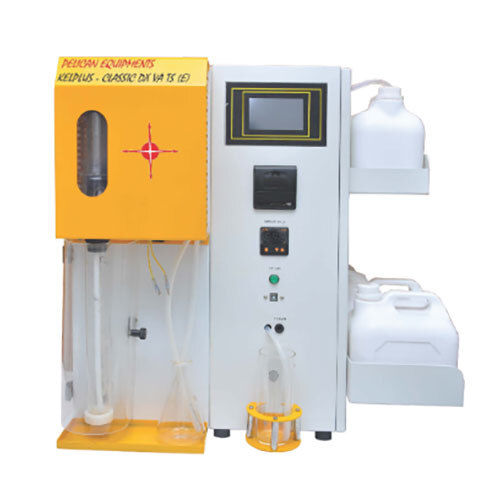
About CLASSIC DX VA TS (E) Automatic Distillation System with Touch Screen Display Version
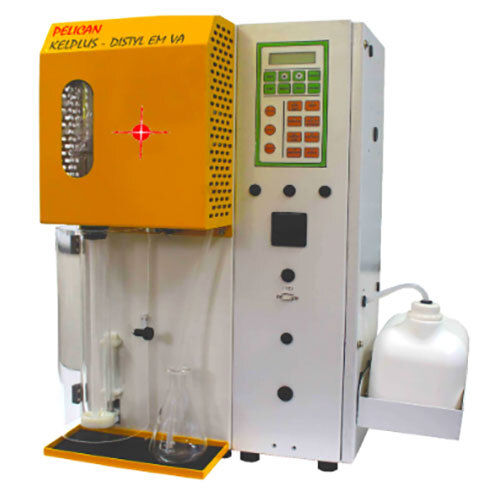
- Auto sequencing Programmable Microprocessor based Distillation with inbuilt software, Colour Touch Screen high resolution TFT LCD Display,
- Application: Total Nitrogen, Organic Nitrogen, Protein Determination, Available Nitrogen, Nitrate Nitrogen, Nitrite Nitrogen, Ammonical Nitrogen, Devarda Nitrogen Determination
- Auto Intelligent run of programmable steps, Addition of Boric Acid, Dilution, KMNO4 Addition for Available Nitrogen, Alkali Addition, Steam Processing, Residue Removal, Process over indication with inbuilt delay time features, Auto Titration Connectivity feature for future upgradation, Aspiration of Receiver Residue, Instantaneous results on input of titre value with inbuilt formula for Nitrogen, Available Nitrogen, Ammonical Nitrogen etc. without connecting to pc. Complete Automatic safety features.
- The suction module of waste residue is door mounted for easy serviceability.
- Facility to program and control distillate volume for determination of available nitrogen
- Enables Automatic monitoring and measuring of high temperature in distillate with sensor for auto warning signal and safety alarm to alert user to control distillate temperature. Temperature displayed digitally.
- Auto reagent Level Sensor with Alarm for Reagents, Stainless steel non corrosive steam Generator
- Reagent tanks (2 litres) wall mounted for easy handling and users visibility.
- The control panel unit along with inbuilt temperature controller, timer, mother board and SMPS is isolated in separate control tower (not rack mounted internally) and housing to protect electronics from wet chemistry & acid/ alkali process area for longevity and safety of all electronic components, with separate access door for main unit & electronics control tower unit.
- Equipment incorporates transparent view window to watch the distillation process & splash head.
- Non Corrosive robust metallic condenser
Payment Terms : 50% while placing Order and 50% before despatch of Equipment.
Advanced Touchscreen User InterfaceNavigate all functions seamlessly with the large color touchscreen display. The intuitive graphical interface allows easy protocol programming, real-time monitoring, and access to internal data logs. Icon-based navigation and on-screen prompts minimize user error while streamlining workflow, making it ideal for both novice and experienced operators in laboratory environments.
Comprehensive Safety & ComplianceThis system is engineered with multiple safeguards, including auto cut-off, overtemperature protection, and a glass break sensor. These features ensure equipment longevity and laboratory safety. Built from borosilicate glass and chemical-resistant materials, it also fully complies with respected international standards such as OIV, AOAC, ISO, and DIN, providing trustworthy results in regulated laboratories.
Efficient & Flexible OperationHandle up to six samples per hour with programmable protocols, making it suitable for variable sample loads and testing requirements. Both direct and manual water filling options with automatic level sensing, as well as automated drainage and integrated fume extraction, offer maximum operational convenience. The tool-free glassware assembly streamlines both routine use and maintenance, reducing downtime.
FAQ's of CLASSIC DX VA TS (E) Automatic Distillation System with Touch Screen Display Version:
Q: How does the CLASSIC DX VA TS (E) ensure accurate and reproducible distillation results?
A: Accuracy is achieved through electronic auto-calibration, a microprocessor-controlled system, and precision-engineered ceramic infrared heating. Temperature control is highly precise to 0.1C, and compliance with OIV, AOAC, ISO, and DIN standards guarantees results are reliable and reproducible for regulated laboratory testing.
Q: What sample volume can this automatic distillation system accommodate, and how many samples can it process per hour?
A: The CLASSIC DX VA TS (E) is designed to handle sample volumes ranging from 50 ml to 400 ml. With its rapid heating and streamlined processes, it can efficiently process up to six samples per hour, making it suitable for laboratories with moderate to high throughput requirements.
Q: When should I use direct or manual water filling, and how does the level sensor function?
A: You can select either direct water supply for continuous operation or manual fill when a fixed water source isn't available. The integrated level sensor monitors water availability automatically, ensuring there is enough water for safe distillation and protecting the heating element from dry running.
Q: Where can this distillation system be installed and what environmental conditions are required?
A: This analyser is suitable for wine, food, and chemical laboratories. It operates efficiently within an ambient temperature range of 5C to 40C. Its compact footprint and robust construction make it easy to install on standard lab benches, and the chemical-resistant chassis ensures durability in various lab environments.
Q: What is the process for distillation and how is safety maintained during operation?
A: Utilizing programmable steam distillation protocols, the system automatically manages heating, condensation, and sample collection. Safety is supported by auto cut-off controls, overtemperature monitoring, glass break sensors, and an integrated fume extraction system, all of which protect users and equipment throughout the process.
Q: How is data managed and exported for record-keeping or analysis?
A: All test data is stored internally and can be quickly exported via the built-in USB port to a PC, facilitating easy integration into laboratory information systems or record-keeping protocols.
Q: What are the key benefits of using this fully automatic distillation analyser in a laboratory setting?
A: Benefits include fully automated operation for consistent results, advanced safety features to protect both users and equipment, programmable protocols to support a variety of tests, and comprehensive connectivity and data export options, all contributing to increased efficiency and reduced risk of error.
 Send Inquiry



 Send Inquiry

 Send Inquiry


